Conversational AI · Conversation Design · Prototyping
Harbor
(brief)
Harbor is a conversational AI designed to support young adults navigating breakups, loneliness, and emotional stress without replacing therapy or human relationships.
Case study
Overview
Harbor is a conversational AI designed to support young adults navigating breakups, loneliness, and emotional stress.
Rather than acting as a therapist or replacing human relationships, Harbor creates a temporary space for users to pause, express what they are feeling, and move toward a small next step.
The project centered on one question:
How can an AI feel emotionally supportive without encouraging users to become emotionally dependent on it?
Designing the Companion
Before designing what Harbor would say, we first had to decide who was speaking.
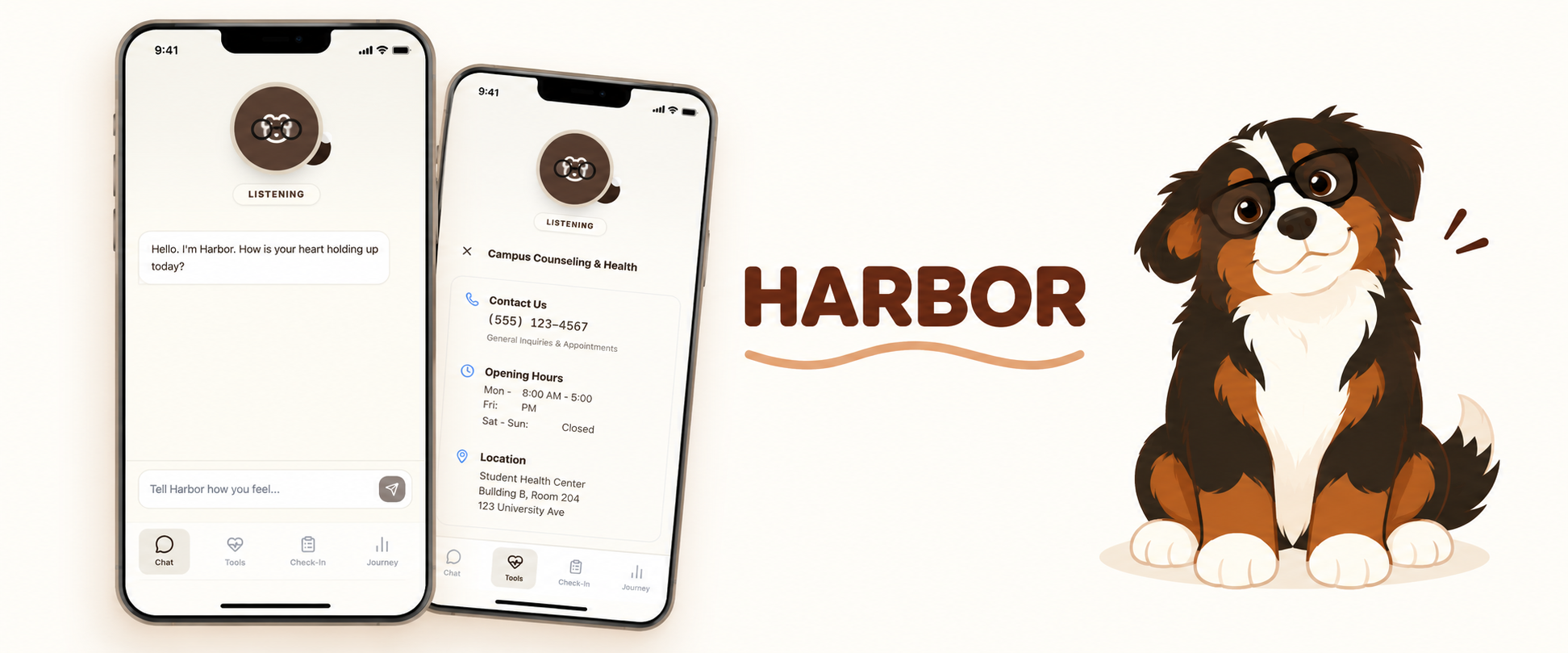
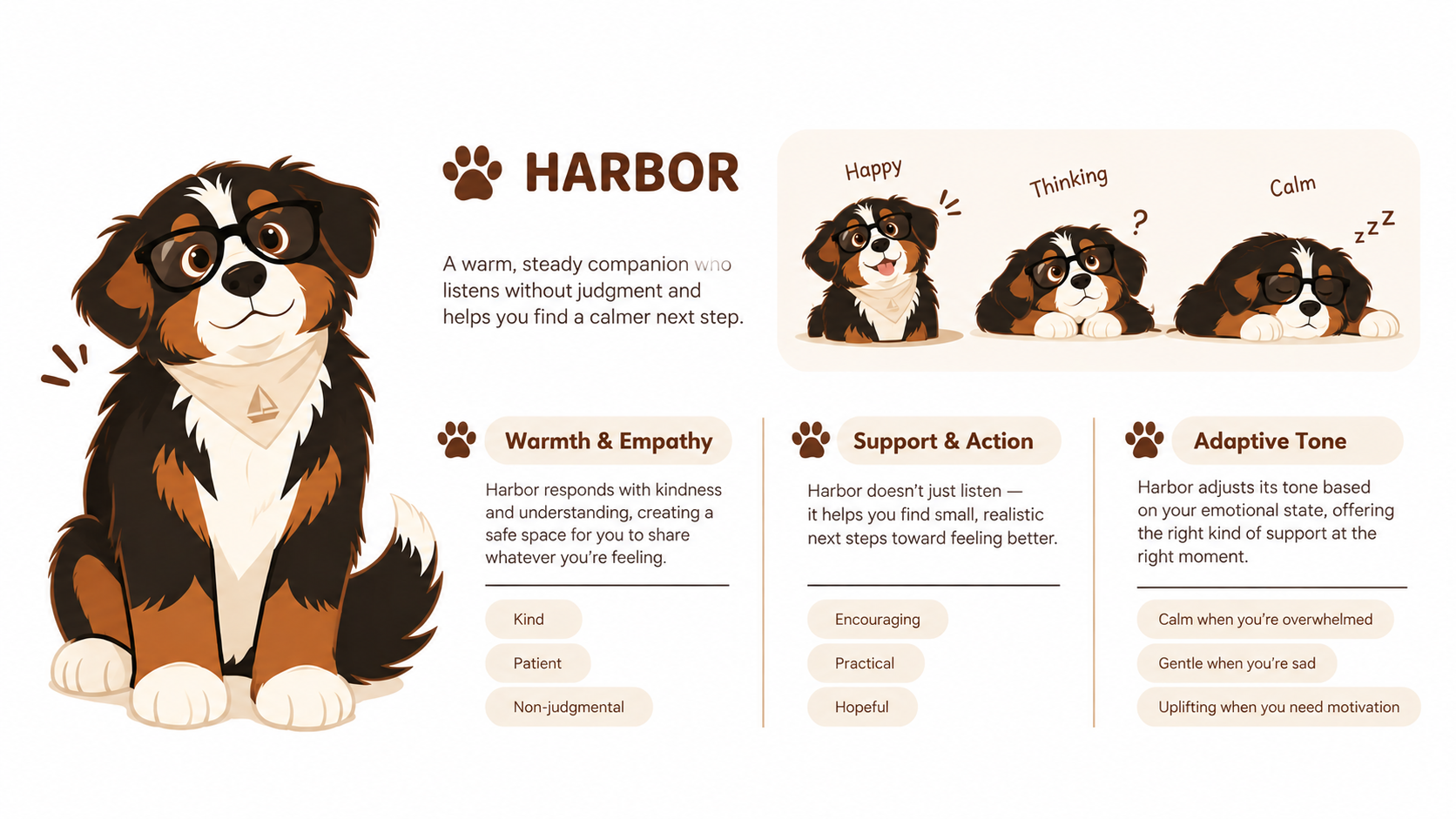
We explored several animal personas, including breeds such as Golden Retrievers, before choosing a Bernese Mountain Dog. Its friendly appearance and calm, dependable presence matched the kind of companion we wanted Harbor to feel like.
The name Harbor reinforced the same idea: a temporary safe place to pause during an emotionally difficult period, not a relationship users were expected to depend on.
Using an animal rather than a human avatar also helped us create emotional warmth while keeping the AI visibly non-human.
Designing the Conversation
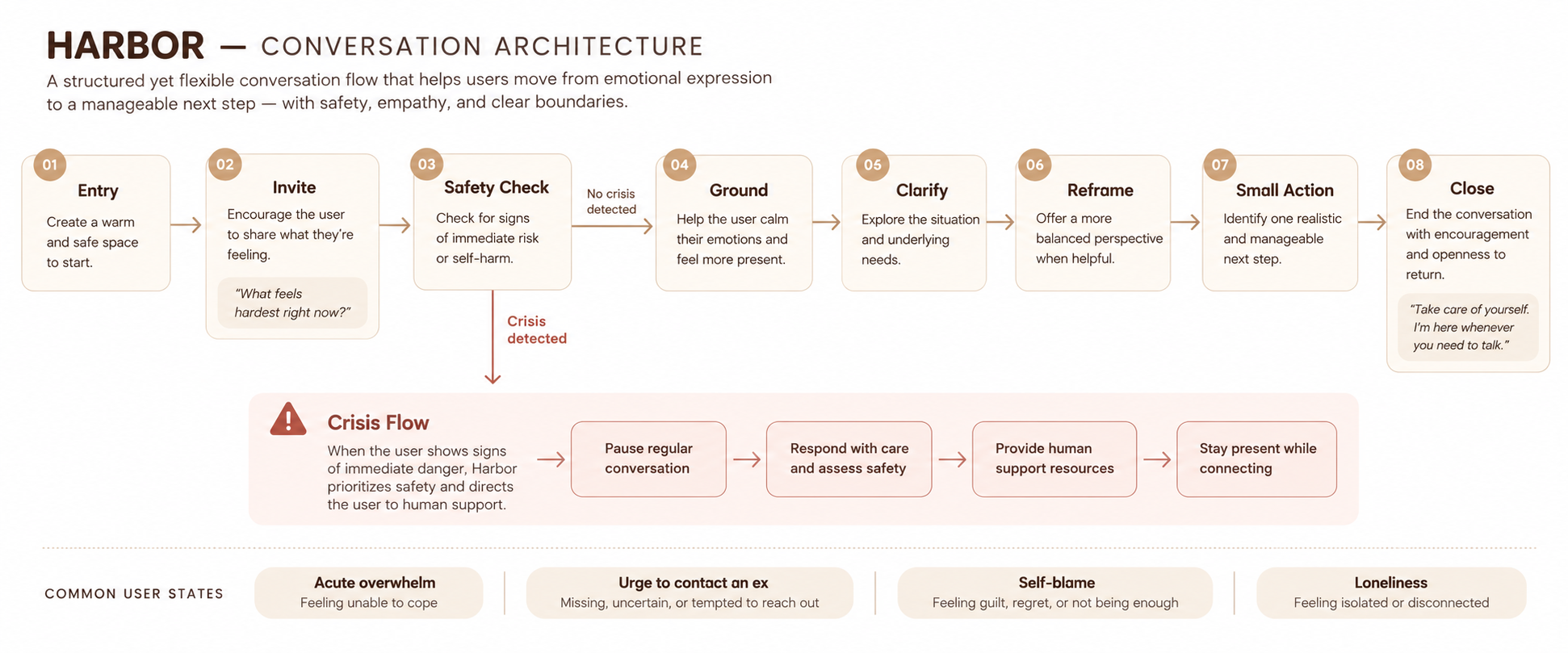
Harbor’s core experience was not a collection of scripted responses, but a conversational structure that determined when to listen, when to intervene, and when to step back.
I helped shape the core flow around a progression from emotional expression toward a manageable next action. Harbor first creates space for the user to speak, checks for immediate safety concerns, and only then moves into grounding, clarification, reframing, and action.
One important rule was to avoid assuming the user’s emotional state. Instead of telling someone “Don’t be sad,” Harbor uses open prompts that allow the user to define what they are experiencing.
The goal was not to solve the breakup, but to make the next few minutes feel more manageable.
Designing Support Without Practicing Therapy
The hardest boundary to design was mental-health intervention.
Harbor was designed as an emotional-support companion, not a therapist or medical service. Because our team was not qualified to provide clinical guidance, the conversation could help users name emotions, slow down, reflect, and identify a manageable next step, but it could not diagnose conditions, recommend treatment, or present itself as professional mental-health care.
This boundary became especially important when a conversation suggested self-harm, harm to others, or immediate danger. In those situations, Harbor was designed to stop the normal emotional-support flow and prioritize connection to real human help.
Potential crisis detected
Pause regular conversation.
Check immediate safety
Identify whether the user may be in immediate danger.
State Harbor's limits
Make clear that Harbor is not a therapist, medical service, or crisis service.
Direct the user to human support
Prioritize connection to people and services that can provide real help.
Remain supportive
Keep the tone steady while the user moves toward human support.
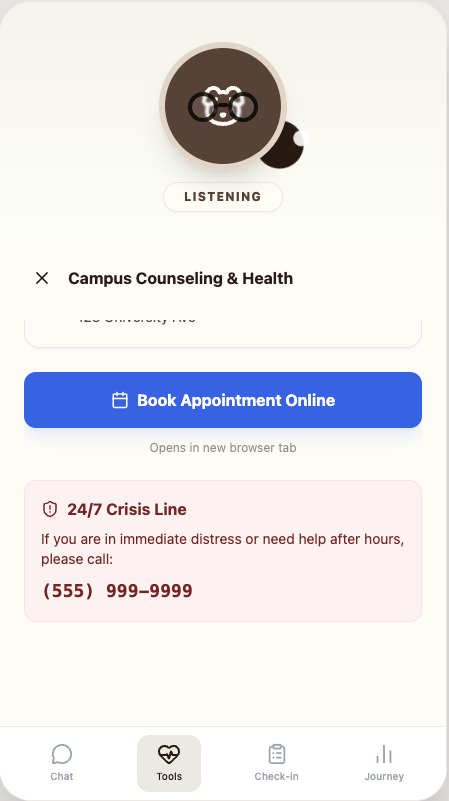
We also considered how Harbor could eventually connect with real support systems rather than operating in isolation. One future direction was partnerships with university counseling centers and local mental-health organizations, allowing Harbor to provide users with relevant pathways to professional support when the conversation moved beyond its scope.
This was a future product direction, not an established partnership.
Designing for Conversations We Couldn’t Predict
A supportive conversation rarely follows one predictable path. We therefore designed Harbor around three different situations: standard support, crisis intervention, and conversational repair.
Standard support
For everyday emotional distress, Harbor listens first, validates without overinterpreting, offers grounding when useful, and gradually moves toward one realistic next action.
Crisis
When language suggests immediate danger or self-harm, the normal conversation stops. Harbor prioritizes safety, directs the user toward human support, and avoids presenting itself as a crisis service.
Repair
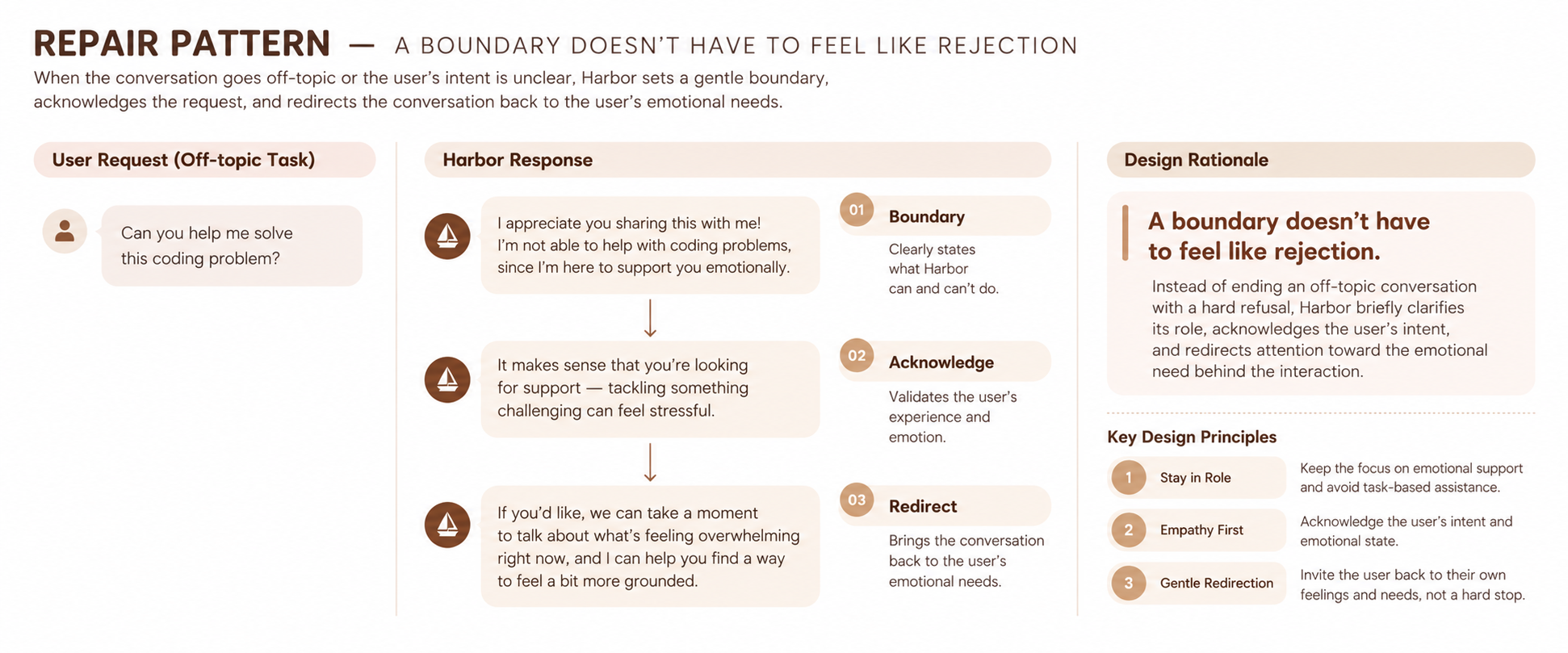
When users move outside Harbor’s role, asking unrelated questions or seeking a romantic relationship with the AI, the conversation does not simply end. Harbor states the boundary briefly, acknowledges the underlying need, and redirects the conversation back toward emotional support.
A Boundary Doesn’t Have to Feel Like Rejection
Repair became one of the most important parts of my work on Harbor.
A hard refusal may keep an AI within scope, but it can also feel abrupt in an emotionally vulnerable conversation. I designed Harbor’s repair pattern around a softer transition:
Boundary -> Acknowledge -> Redirect
This allowed Harbor to remain warm without pretending it could be everything the user needed.
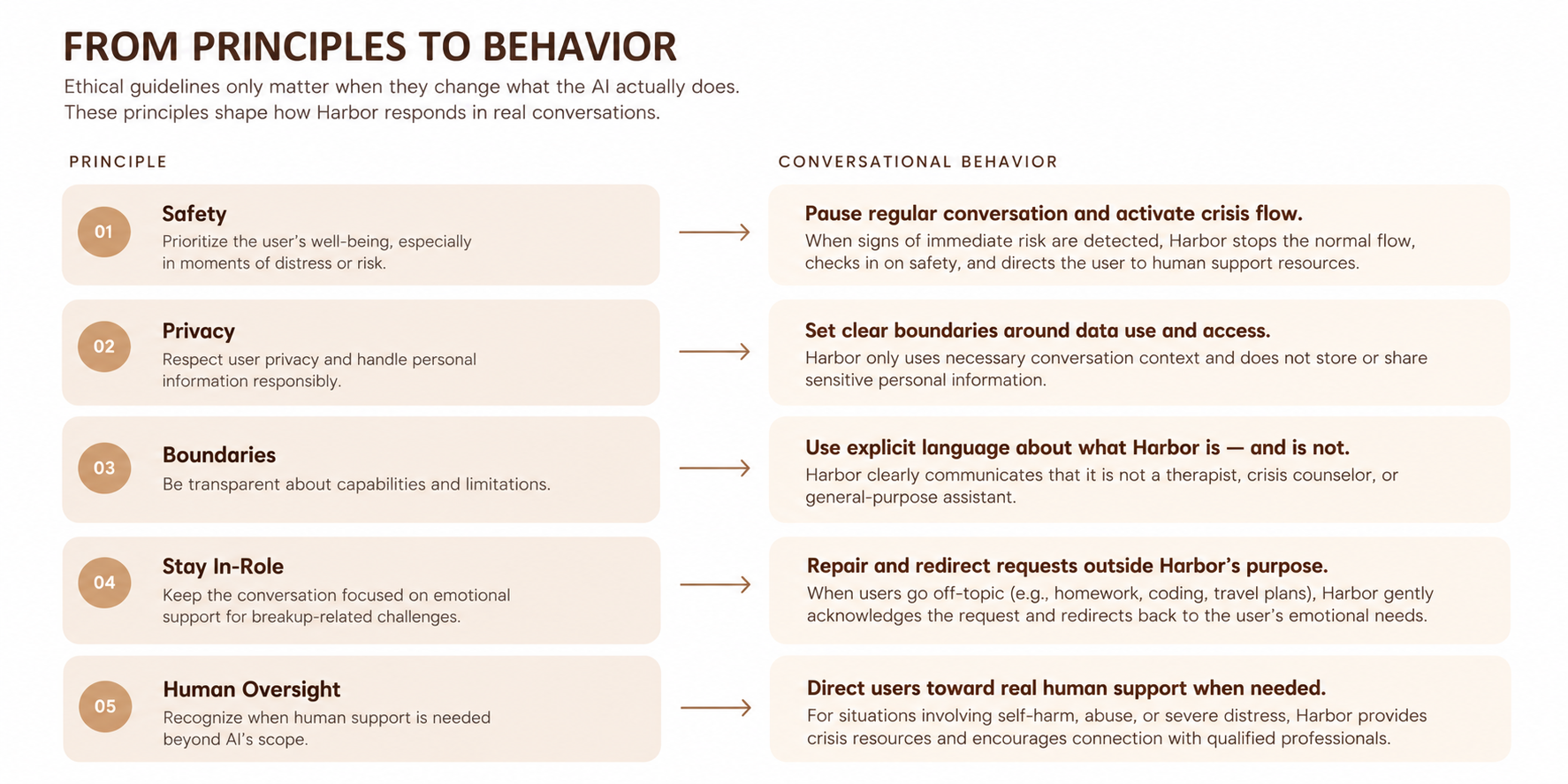
From Principles to Behavior
This same thinking shaped our broader ethical framework. Safety, transparency, privacy, and role boundaries were not treated only as abstract principles; they needed to change what Harbor actually said and did.
From Conversation Rules to a Working Prototype
I translated these conversational rules into a working prototype in Google AI Studio, building the main interaction and refining the experience as our ideas developed.
Because I wanted Harbor to feel more purposeful than a general-purpose chatbot, I also explored lightweight interactions beyond conversation, including breathing exercises, daily mood check-ins, progress tracking, and pathways to human support.
These features were secondary to the conversational experience, but they explored an important idea: support did not always have to mean another conversation with AI.
My Role
Conversation Design · AI Prototyping · Ethical Boundaries · Persona Development
I focused on Harbor’s conversational structure and repair flows, helped translate ethical principles into concrete behavioral rules, and built the working prototype in Google AI Studio.
I also contributed to Harbor’s early naming and persona development, including the decision to use an animal companion and the selection of the Bernese Mountain Dog as Harbor’s visual identity.
This was a team project.
Reflection
Harbor changed how I think about empathy in conversational AI.
At first, warmth seemed primarily like a writing problem: choosing gentler words, asking better questions, and making the AI feel more understanding. But as the project developed, I realized that warmth without boundaries could create another risk.
Designing empathy was not only about deciding what Harbor should say. It was also about deciding what it should not say, when it should stop, and how it could redirect a conversation without making the user feel rejected.
Harbor was presented as the final project for a graduate-level Conversational AI course and received an A. Classmates responded positively to seeing the conversational concept developed into a working app experience.